
The Goal
Most B2B buyers don’t buy what they don’t understand. Entity Risk Detection is a powerful product capability, but “entity risk detection” isn’t exactly self-explanatory to a compliance professional trying to figure out if Hawk solves their problem.
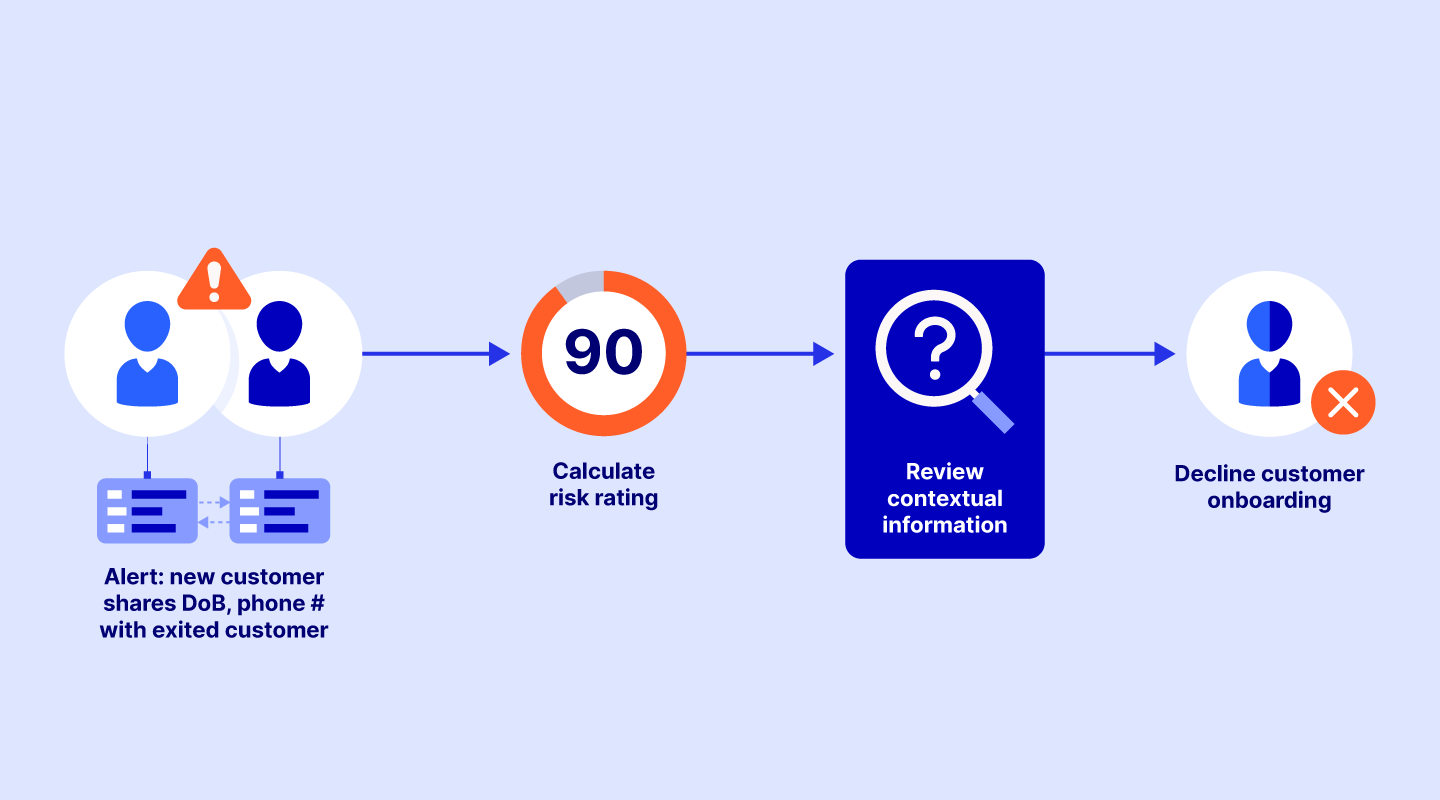
These infographics were designed to close that gap — four use case scenarios that showed exactly how the product works in practice, in situations a financial crime professional would immediately recognize.
The Plan
Show, don’t tell. Rather than describe Entity Risk Detection in abstract terms, illustrate the specific suspicious patterns the product is built to catch: a new customer sharing ID information with an exited customer, three companies registered at the same address, three accounts sharing ID information, and a customer connected to a new business account. Real scenarios, visual format, zero jargon required.
The Process
Working with the CPO to nail down the scenarios, I took the core concepts and figured out how to strip each one down to its visual essence. Complex AFC frameworks don’t naturally lend themselves to clean graphics — the challenge was finding the right level of abstraction. Too simple and you lose the point. Too detailed and you’ve just made a slide nobody wants to look at.
I sketched the layouts myself and briefed a designer to handle the execution. The brief had to be tight enough that the designer could work independently without a background in financial crime compliance. Fewer revision rounds. Fewer passive-aggressive Slack messages. Everyone wins.
The Results
The infographics lived on the Entity Risk Detection product page and in sales enablement materials — two high-intent touchpoints where buyers are actively evaluating the product. No vanity metrics here. This was content designed to help close deals, not rack up impressions.
The Learnings
- Sketching before briefing is worth the extra thirty minutes. A rough hand-drawn layout communicates intent more clearly than a written description ever will. Designers can interpret words in a hundred different ways. They can only interpret a sketch one way.
- Use case scenarios are an underused format in B2B product marketing. Most product pages describe features. Use cases show outcomes. Buyers don’t care what the product does in the abstract — they care whether it catches the specific thing they’re worried about. Show them that it does.
- Sales enablement content has a different job than brand content. Brand content earns attention. Sales enablement content removes objections. Knowing which one you’re building changes every decision, from format to level of detail.


Leave a Reply